Residential Concrete • Oak Grove, MO
Concrete retaining walls in Oak Grove, MO.
Retaining walls hold grade — they define and hold the separation between two elevations in a yard, along a driveway, or at the edge of a patio. A wall that fails has soil movement behind it, water problems, and often damage to adjacent concrete. Getting the drainage, footing depth, and wall thickness right is what separates a wall that holds from one that leans.
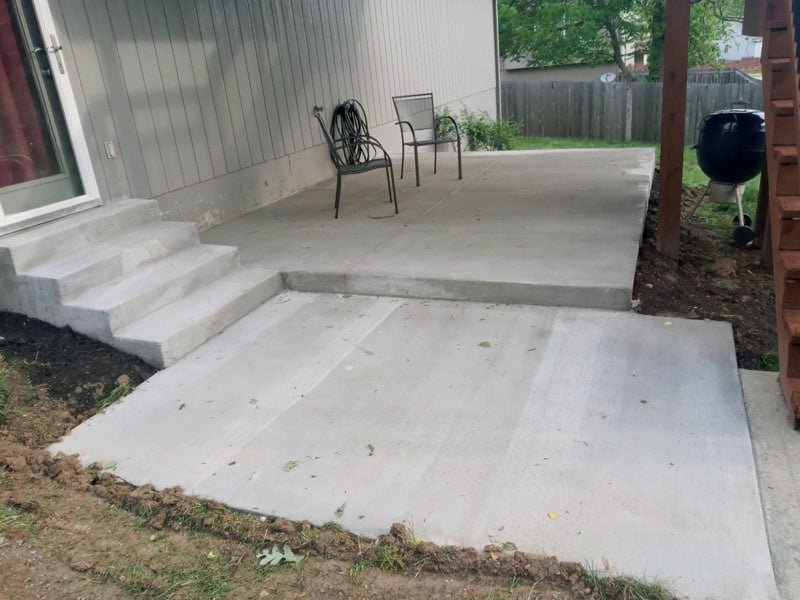
Stable grade, usable yard, and no soil movement.
A correctly built retaining wall creates usable flat space from sloped yard, holds the grade around a driveway or patio, and stays vertical for decades. The visible face is a small part of what makes a wall work — the footing depth below frost line, drainage behind the wall, and wall thickness relative to retained height are what keep it in place.
Call (816) 312-4164What retaining walls includes.
Scope covered under this service for Oak Grove and the east KC metro.
- Poured concrete retaining walls
- Concrete masonry unit (block) retaining walls
- Grade separation for yards, driveways, and patios
- Drainage systems behind walls (gravel backfill, weep holes, French drains)
- Walls integrated with patio or driveway design
- Tiered retaining systems for larger grade changes
- Footing excavation to below frost line
Common reasons people call for retaining walls in Oak Grove.
Sloped yard with no usable flat space
Terracing a sloped yard with retaining walls creates usable flat areas for patios, play areas, and landscaping.
Driveway runs along a slope
Driveways along a grade change need a retaining element to hold the adjacent soil — otherwise erosion and soil movement undermine the driveway edge.
Existing wall is leaning or failing
A wall that's moved — leaning, cracking, or showing soil movement behind it — needs assessment and typically replacement.
Expanding a patio requires a grade change
Adding or enlarging a patio on a sloped lot often requires a retaining wall to create the flat area needed for the patio slab.
Erosion is moving soil toward the house or driveway
Soil migrating downslope toward a home or driveway creates drainage and foundation problems. A retaining wall holds the grade.
What actually matters for retaining walls.
The technical factors that determine whether retaining walls holds up over time in east KC.
01
Drainage behind the wall
Water buildup behind a retaining wall creates hydrostatic pressure that pushes the wall outward. Gravel backfill and weep holes allow water to drain through rather than build up. This is the most common cause of wall failure when it's missing.
02
Footing depth below frost line
Retaining wall footings must go below the Missouri frost line — typically 24-30 inches below grade — to prevent frost heave from lifting and tilting the wall.
03
Wall thickness for retained height
Taller retained heights require proportionally thicker walls. A wall built too thin for the height it holds will fail under the soil pressure.
04
Gravel backfill
Porous gravel behind the wall, rather than native clay soil, reduces hydrostatic pressure and allows drainage to weep holes.
05
Permit requirements
Walls over 4 feet (top of wall to bottom of footing) typically require engineering and permits in most municipalities.
Clay soil and frost depth in east KC.
Clay soil holds water and creates hydrostatic pressure behind retaining walls — which is why drainage behind the wall matters more here than in sandy-soil regions. Frost depth in the east KC metro requires wall footings to go below the freeze line, typically 24-30 inches. A wall installed with inadequate drainage or insufficient footing depth on clay subgrade will show movement within years as clay expands and contracts seasonally.
What the process looks like from call to finished concrete.
Five steps. No surprises in the middle.
01
Call or submit a request — we get back to you quickly.
02
We look at the site: grade change, soil conditions, drainage, and wall height needed.
03
You receive a written proposal with scope, materials, and pricing.
04
We excavate the footing, build the wall, install drainage, and backfill correctly.
05
We walk through the finished wall and drainage system with you.
Get a free retaining wall estimate in Oak Grove.
Free estimates. Done in person. We don't price concrete without seeing the project.