Commercial Concrete • Oak Grove, MO
Warehouse and industrial concrete floors in Oak Grove, MO.
Warehouse and industrial concrete floors support forklift traffic, racking loads, heavy equipment, and daily operational use. Flatness tolerance, slab thickness, joint layout, and surface hardness all matter more here than in any other concrete application — because floor performance directly affects operations.
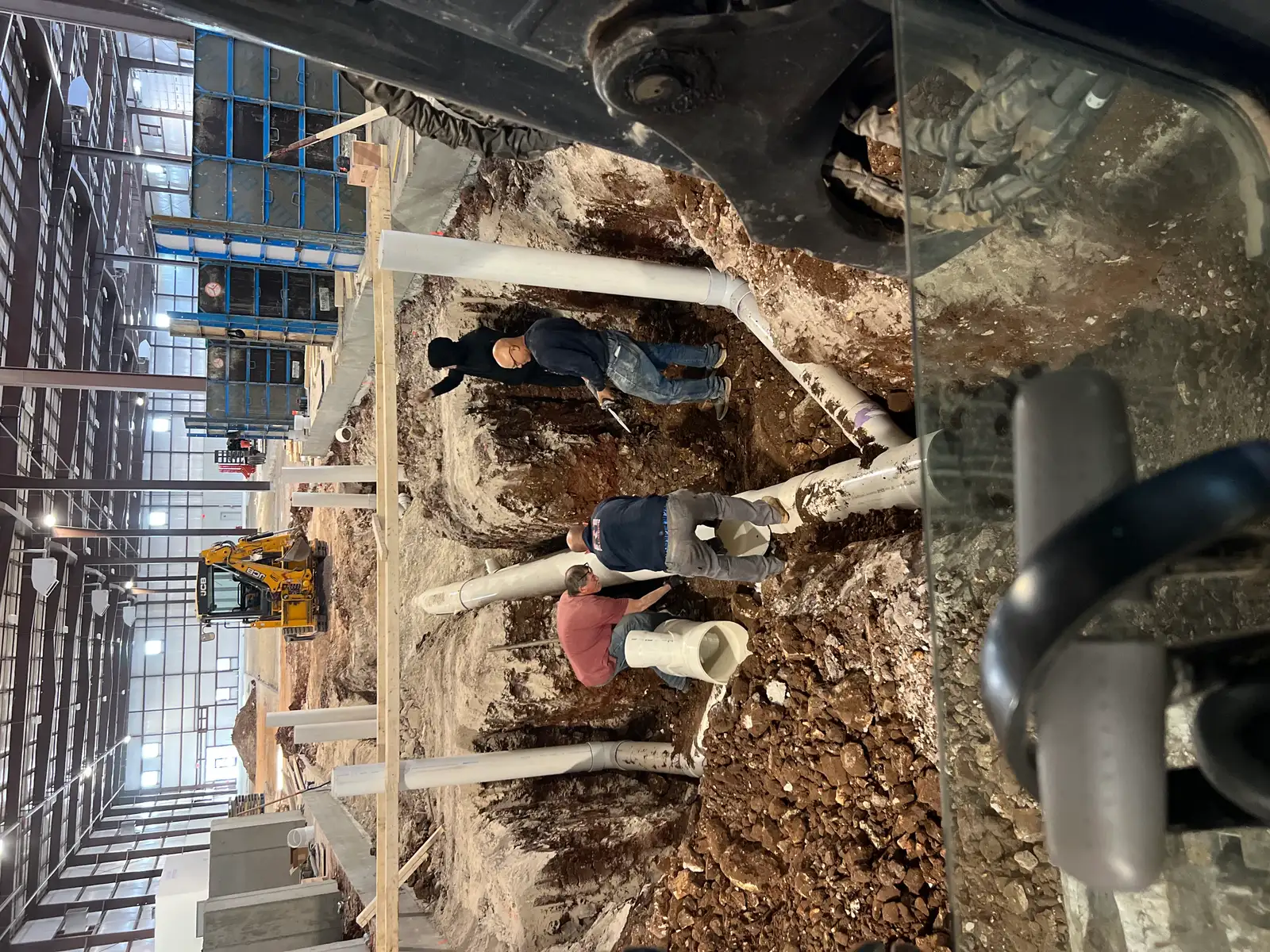
A floor that handles operations without disruption.
An industrial floor poured to the right spec — correct thickness, flatness, surface hardness, and joint layout for the racking and equipment it carries — gives operations a surface that handles forklift turning loads and daily use without cracking or settling. Getting the spec right up front is far less expensive than remediation after the building is occupied.
Call (816) 312-4164What warehouse & industrial floors includes.
Scope covered under this service for Oak Grove and the east KC metro.
- New warehouse floor installation
- Industrial facility and manufacturing concrete floors
- Light manufacturing and distribution center floors
- Equipment pad and machinery foundation within facilities
- Joint layout designed for forklift traffic patterns and racking
- Power-troweled finish for operational surfaces
- Surface hardener application for high-traffic areas
Common reasons people call for warehouse & industrial floors in Oak Grove.
New warehouse or industrial building needs a floor
New commercial construction requires a concrete floor specified for the building's operational requirements — racking, forklift traffic, and surface durability.
Existing floor has deteriorated beyond operational tolerance
Industrial floors deteriorate at joints, at edges, and where surface spalling has created debris and forklift hazards.
Facility is expanding and the addition needs concrete floor
Building expansions require a new floor section that meets the same flatness and thickness spec as the existing area.
Floor joints are in the wrong location for rack layout
Joints placed at rack upright locations create stress points under loaded racking. Joint layout must be coordinated with rack placement.
Surface is dusting or failing under operational load
Floors that were not finished correctly or used the wrong mix develop surface scaling that creates debris in the facility and shortens floor life.
What actually matters for warehouse & industrial floors.
The technical factors that determine whether warehouse & industrial floors holds up over time in east KC.
01
Slab thickness for the load
Light industrial and distribution: typically 5-6 inches. Heavy forklift and high-pile racking: 6-8 inches. We work from the load requirements to determine the specification.
02
Flatness tolerance (F-numbers)
F-numbers — FF (flatness) and FL (levelness) — describe how flat and level the slab is. Rack-supported systems have flatness requirements that affect safe forklift operation. Defined traffic lanes have tighter tolerances than random traffic areas.
03
Joint layout relative to racking and traffic
Joints placed incorrectly relative to racking uprights and forklift travel lanes create stress concentration and early deterioration at those locations.
04
Subbase preparation and vapor barrier
Well-compacted subbase prevents long-term settlement. Vapor barrier under the slab is standard for buildings where humidity and moisture control matters.
05
Power-troweled surface finish
Power troweling creates a hard, dense surface layer that handles operational loads and can be cleaned. Wet-finished or broom-finished surfaces wear faster under industrial traffic.
Industrial floors and east KC logistics properties near I-70.
The east KC metro near I-70 has a significant logistics and light industrial presence. Industrial floor specs for these properties need to account for racking loads, forklift turning movements at dock doors, and the joint layout requirements of the racking system. Vapor barrier under the slab is standard for buildings where humidity control matters — common in food storage and climate-controlled distribution facilities.
What the process looks like from call to finished concrete.
Five steps. No surprises in the middle.
01
Call or submit a request — we get back to you quickly.
02
We discuss the facility requirements: racking layout, forklift specs, flatness tolerance needed.
03
You receive a written proposal with slab spec, joint layout plan, and pricing.
04
We prepare subbase, place vapor barrier, set forms and reinforcement, and pour to spec.
05
After cure, we verify flatness and walk through the floor with you before handoff.
Questions about warehouse & industrial floors in Oak Grove.
More questions? Browse all FAQs or call us directly.
Related concrete services
Get a free warehouse floor estimate in Oak Grove.
Free estimates. Done in person. We don't price concrete without seeing the project.