Residential Concrete • Oak Grove, MO
Concrete sidewalks and walkways in Oak Grove, MO.
Walkways connect a property's main entry to the driveway, garage, backyard, and street. They need to stay flat, drain correctly, and not develop the kind of differential settlement — even a quarter-inch lift between panels — that becomes a trip hazard over time.
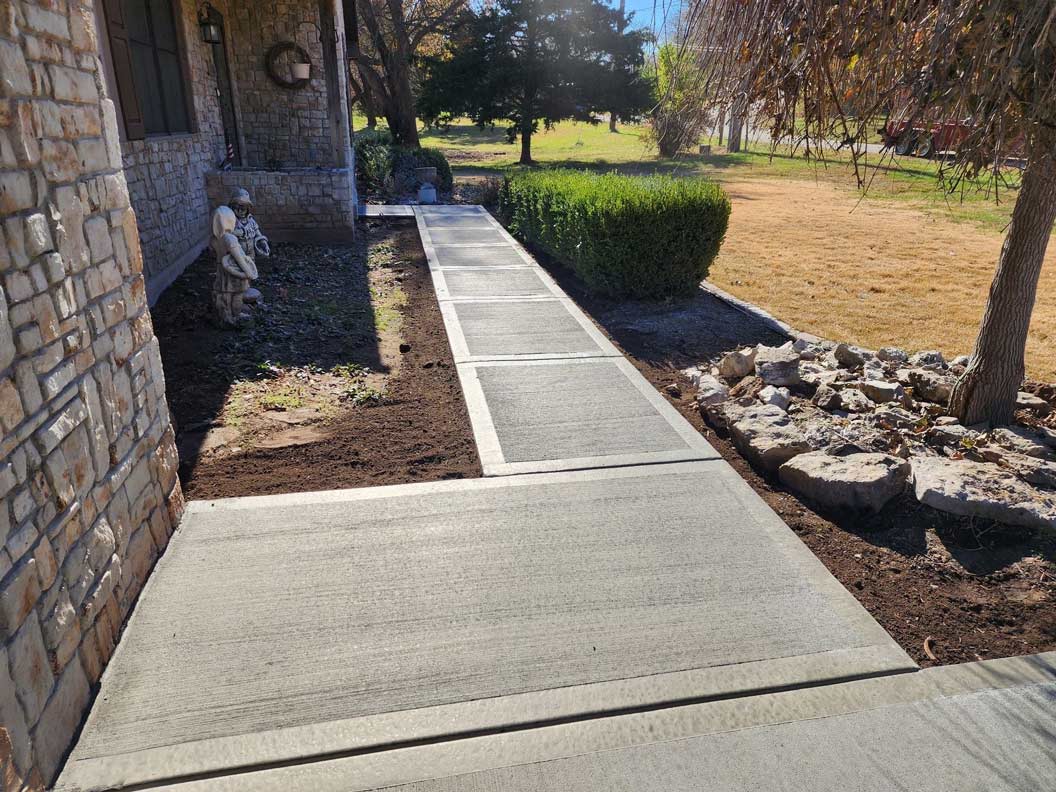
Safe, flat paths that stay that way.
A walkway poured on prepared base with correctly spaced joints and appropriate thickness for foot traffic stays flat for decades. The main failure modes — root intrusion, inadequate base preparation, and missing control joints — are all preventable at installation. When a walkway does fail, replacing the affected panels correctly gets the path back to safe and functional.
Call (816) 312-4164What sidewalks & walkways includes.
Scope covered under this service for Oak Grove and the east KC metro.
- Front entry walkways and paths to the street
- Side yard and backyard paths between structures
- Paths to garages, sheds, outbuildings, and pool areas
- Public sidewalk replacement subject to local requirements
- Trip hazard repair and individual panel replacement
- Decorative borders and accented walkway designs
- New access routes for additions and property changes
Common reasons people call for sidewalks & walkways in Oak Grove.
A section has raised and become a trip hazard
Differential settlement — one panel higher than the next — creates a trip hazard. Quarter-inch or more of vertical offset is the typical threshold for concern, especially near entries.
Tree roots have pushed sections up
Root intrusion under walkways is the most common cause of lifted panels in established neighborhoods in Oak Grove, Blue Springs, and Independence.
No defined path from driveway to front door
Properties without a walkway rely on grass or unpaved areas that become muddy and worn. A concrete walkway solves this permanently.
Part of a larger driveway or patio project
Walkway replacement often makes sense when adjacent driveways or patios are being replaced, creating a clean, unified connection.
Adding access to a new structure or backyard area
New garages, workshops, sheds, or outdoor spaces need defined paths from the main house.
What actually matters for sidewalks & walkways.
The technical factors that determine whether sidewalks & walkways holds up over time in east KC.
01
Control joint placement
Joints every 4–6 feet on walkways give the concrete somewhere to move from temperature change and limit how far root intrusion can lift before a joint interrupts the section.
02
Root proximity
Tree roots grow under and lift concrete walkways. Walkways near large trees may need root barriers, deeper forms, or an alternate route to reduce the problem long-term.
03
Slab thickness
3.5 to 4 inches for standard foot traffic — enough to handle everyday use without being excessive.
04
Grade and drainage
A flat walkway that doesn't drain will develop ice in winter and water damage over time. Slight cross-slope moves water to the edge.
05
Edge restraint and forms
Walkway edges are where freeze-thaw stress is most concentrated. Proper forming and compaction at the edges prevent early edge chipping.
Tree roots and clay soil in east KC neighborhoods.
Tree root intrusion is one of the primary causes of walkway failure in residential neighborhoods in Oak Grove, Blue Springs, and Independence. Roots grow under slabs and lift sections unevenly, creating trip hazards that often require individual panel replacement rather than full walkway replacement. Clay soil movement causes the same settling and heaving issues as with driveways. Joint placement and appropriate base depth help, but proximity to large mature trees is a real factor in how long a walkway stays flat.
What the process looks like from call to finished concrete.
Five steps. No surprises in the middle.
01
Call or submit a request — we get back to you quickly.
02
We look at the path, assess existing conditions, root proximity, and drainage.
03
You receive a written proposal with scope and pricing.
04
We set forms, pour, and finish each section with correct joints and grade.
05
After cure, we explain timeline for foot traffic and any maintenance notes.
Questions about sidewalks & walkways in Oak Grove.
More questions? Browse all FAQs or call us directly.
Related concrete services
Get a free walkway estimate in Oak Grove.
Free estimates. Done in person. We don't price concrete without seeing the project.